Introduction
Digital devices have changed the way people take notes, organize information, and manage their daily work. Laptops are useful for complex tasks, smartphones provide quick access to information, and conventional tablets support a wide range of applications. However, not everyone wants to work on a bright screen filled with notifications, colorful interfaces, and multiple distractions. For people who prefer the simplicity of handwriting, a digital paper tablet offers a different approach.
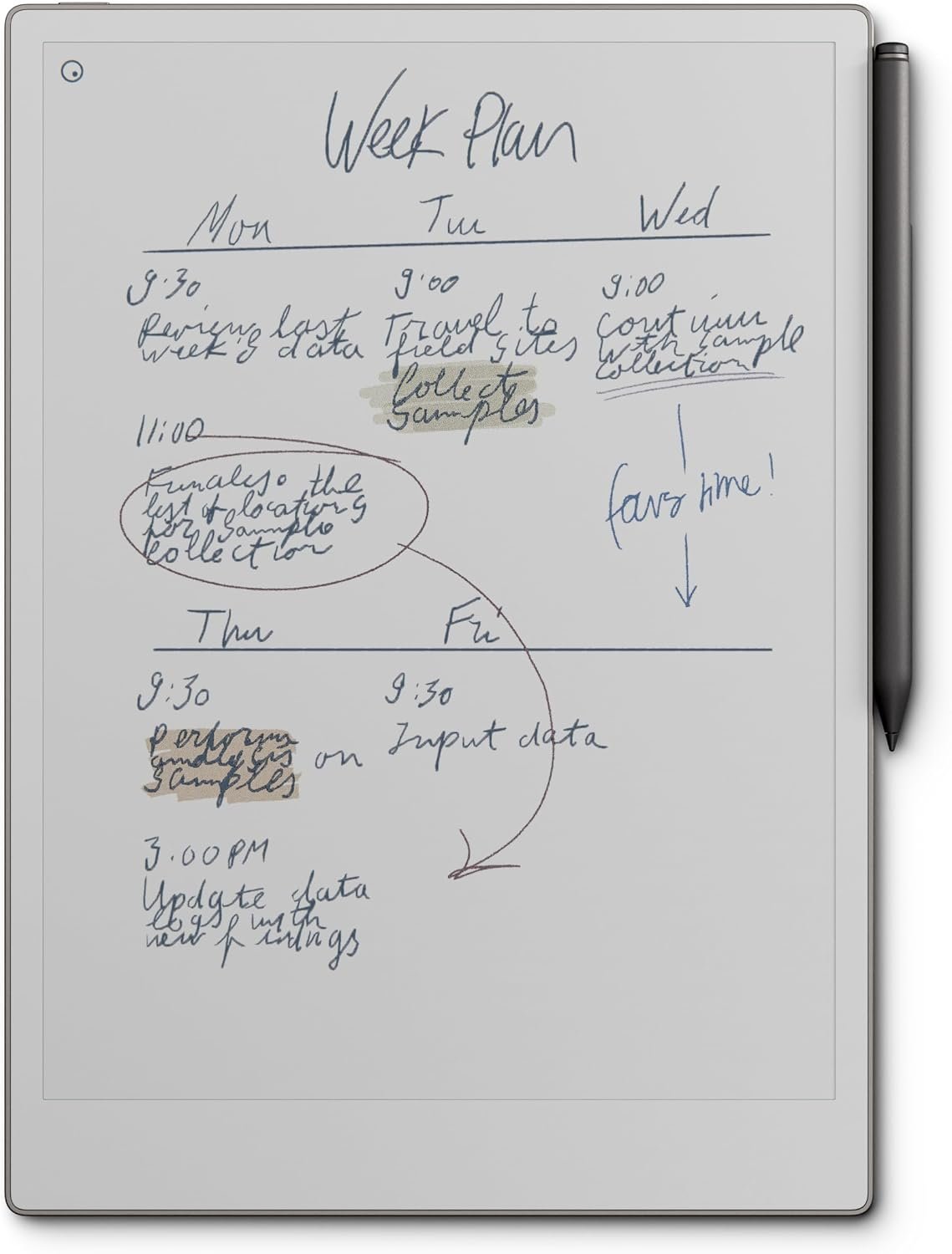
The reMarkable Paper Pro with Marker Plus is designed for people who want to write, annotate documents, sketch ideas, and organize handwritten information in a digital environment. It combines a paper-oriented writing experience with the convenience of electronic storage and document management. Rather than functioning as a conventional entertainment tablet, it focuses on reading, writing, and working with documents.
This type of device may be relevant to students, professionals, writers, researchers, designers, and anyone who regularly works with handwritten notes. It can provide a dedicated space for meeting notes, study materials, brainstorming sessions, project planning, and document annotation without requiring stacks of paper notebooks.
The reMarkable Paper Pro also belongs to a growing category of devices that prioritize focused work. Instead of emphasizing games, video streaming, and general-purpose applications, its design centers on digital handwriting and reading. This specialized approach can be appealing to people who want to separate their note-taking activities from the distractions associated with a phone or laptop.
The bundle includes the reMarkable Paper Pro tablet and Marker Plus, a digital writing accessory intended to support handwritten input. The precise capabilities, included accessories, software features, and compatibility options should always be confirmed through the current Amazon product listing and the manufacturer’s documentation, as product bundles and software capabilities can change.
Understanding how the reMarkable Paper Pro works, what it can help with, and where its limitations may matter can make it easier to determine whether this digital paper tablet fits a particular workflow.
Understanding the reMarkable Paper Pro
The reMarkable Paper Pro is a digital writing and reading device built around an electronic paper display. Electronic paper technology is designed to provide a different visual experience from the standard LCD or OLED screens found on many tablets, phones, and computers.
Its main purpose is to make common paper-based activities available in a digital format. Instead of carrying several notebooks, users can keep different sets of notes on one device. Instead of printing every document that requires handwritten comments, they can work with supported digital documents. Instead of keeping brainstorming sessions on loose sheets of paper, they can organize ideas into digital notebooks.
The device is especially relevant for people who use handwriting as part of their thinking process. Writing by hand can be useful for outlining a project, summarizing a lecture, planning a presentation, or connecting ideas during a brainstorming session. A digital paper tablet allows these activities to take place without requiring a new physical notebook for every subject.
The distinction between a digital paper tablet and a conventional tablet is important. A general-purpose tablet typically offers broad app support and multimedia capabilities. A device focused on digital paper instead concentrates on a smaller set of activities related to writing, reading, and document organization.
Neither approach is universally suitable for everyone. The right choice depends on how someone works, which features they need, and whether they prefer a focused writing environment or a more versatile digital platform.
Key Features of the reMarkable Paper Pro with Marker Plus
1. A Color Electronic Paper Display
One of the defining characteristics of the reMarkable Paper Pro is its color electronic paper display. Unlike a conventional tablet screen designed for high-refresh-rate video and colorful applications, an electronic paper display prioritizes a reading and writing experience that resembles working with printed material.
Color can be useful when organizing information visually. For example, a student might distinguish definitions from examples, while a project manager could use different colors to separate priorities, questions, and completed tasks. A researcher might mark sections of a document according to their importance, and a designer could use color to distinguish different elements in a rough concept.
The usefulness of a color electronic paper display depends on the type of work being performed. It can support visual organization and document annotation, but it should not automatically be treated as equivalent to a conventional tablet display for photography, video, or color-critical creative work.
People who regularly edit images, watch high-definition video, or work with detailed visual content should consider whether an electronic paper screen meets their requirements.
For handwriting, reading, and organizing notes, however, the display technology reflects the device’s central purpose: making written information easier to work with in a dedicated digital environment.
2. Handwriting with Marker Plus
The Marker Plus accessory is an important part of the reMarkable Paper Pro bundle. It provides a way to write directly on the tablet rather than entering every note through a keyboard.
Handwriting can be particularly useful when information needs to be captured quickly. During a meeting, for example, someone may want to record a few key points, draw a simple diagram, or connect related ideas with arrows. In a classroom, a student may find it easier to write a formula or sketch a process than to construct it using typed text.
Marker Plus is designed for this paper-oriented writing workflow. Its physical design and supported writing functions should be checked against the manufacturer’s current specifications, especially if particular pen behaviors or accessories are important to the intended use.
A digital writing accessory can also make it easier to maintain a consistent note-taking habit. Users can open a notebook, write down information, and keep the result with their other digital documents. This reduces the need to decide which physical notebook to carry for different activities.
People considering the bundle should also check the included accessories and charging or storage requirements. These practical details can affect how convenient the complete setup is for daily use.
3. A Digital Notebook System
A major advantage of digital note-taking is the ability to maintain multiple notebooks without carrying separate physical books.
A student could create one notebook for each course. A consultant might keep separate notebooks for clients or projects. A writer could maintain dedicated spaces for outlines, character ideas, research notes, and revisions. Someone managing personal responsibilities could separate weekly plans, household tasks, and long-term goals.
This structure helps make a large collection of notes more manageable. Rather than keeping information across scattered pages, users can organize their work according to subjects, projects, or recurring activities.
A digital notebook can also support different styles of thinking. Some people prefer linear notes, while others use mind maps, diagrams, lists, and visual connections. Handwriting-oriented devices are useful for workflows where the structure of the page matters as much as the words themselves.
The effectiveness of any notebook system still depends on how it is organized. A large collection of digital pages can become difficult to navigate if files are given unclear names or if users create notebooks without a consistent system.
A simple naming convention, such as a project name followed by a date, can make future retrieval easier. Regularly reviewing and organizing notes can also help maintain a useful digital archive.
4. Document Reading and Annotation
Many people need to read documents while adding their own comments. Students annotate study materials, professionals review reports, and researchers make notes while examining articles or reference documents.
A digital paper tablet can provide a way to work with supported document formats without printing every file. Depending on the available software features and document compatibility, users may be able to highlight passages, add handwritten comments, mark important sections, or sketch directly on a document.
This can be useful when preparing for a meeting. A person might review an agenda beforehand, add questions beside relevant sections, and refer to those notes during the discussion. Afterward, the annotated document can serve as a record of the issues that require follow-up.
Document annotation can also support academic work. A student could add questions to a reading assignment, identify unfamiliar concepts, or summarize a chapter in the margins. A professional reviewing a proposal might mark sections that need clarification.
Compatibility should not be assumed for every file or document layout. Complex forms, interactive documents, unusual formatting, and files with specific software requirements may behave differently from ordinary reading documents. Users should confirm supported formats and annotation options before relying on the device for a particular document workflow.
5. Digital Organization for Everyday Work
A paper-based workflow often involves a mixture of notebooks, printed documents, sticky notes, and loose sheets. Over time, this collection can become difficult to maintain.
A digital paper tablet offers an alternative by keeping many of these materials in one place. Notes can be separated into folders or notebooks, while documents can be stored alongside related work. This arrangement may reduce the amount of physical paper someone needs to carry.
Consider a professional who attends several meetings each week. One notebook could contain internal planning notes, another could hold project discussions, and a third could be dedicated to personal development. Keeping these records organized digitally can make it easier to maintain a consistent process.
The same principle applies to studying. Rather than carrying several notebooks to a library, a student can use a single device to access relevant digital notes and supported reading materials.
Digital organization does not eliminate every administrative task. Files still need to be named, reviewed, backed up where appropriate, and organized in a way that makes sense to the user. The device is most useful when its digital structure supports an established workflow instead of becoming another place where information accumulates without a plan.
6. A More Focused Writing Environment
Many digital devices are designed to support several activities at once. Notifications, social media, messaging applications, and entertainment services can interrupt concentration even when the original task is simple.
A device focused on writing and reading offers a different approach. By emphasizing a narrower set of activities, the reMarkable Paper Pro can provide a dedicated space for work that benefits from fewer distractions.
This may be particularly relevant for people who struggle to keep their attention on handwritten notes while using a smartphone or computer nearby. Opening a digital notebook and writing directly on the page can make the activity feel more deliberate.
For example, a writer could use the tablet to outline an article before moving to a computer for editing and publishing. A student could summarize a lecture without switching between a note-taking application and unrelated notifications. A manager could draft meeting notes without repeatedly opening email.
The extent of this benefit depends on the user’s habits. A focused device cannot guarantee better concentration, and some workflows still require access to external applications. Nevertheless, keeping writing separate from more distracting digital activities may help people establish a clearer routine.
7. Digital Storage and Access to Notes
Physical notebooks can be difficult to search, particularly when information has been recorded over several months or years. A digital notebook system can make long-term storage more convenient, provided the user maintains an effective organizational structure.
The reMarkable Paper Pro is intended to store digital notes and documents. Depending on the software version, account configuration, and supported features, users may also have options for moving files between the device and other systems.
These capabilities can help support workflows that extend beyond the tablet itself. A person may write notes on the device, organize them into folders, and later access or export supported files for additional work.
However, digital storage should not be confused with automatic universal access. Synchronization features may depend on account settings, compatible applications, internet connectivity, and service terms. Users should check current documentation for details about cloud synchronization, offline availability, storage limits, export formats, and subscription requirements.
For important professional or academic records, it is sensible to understand how files can be exported and backed up before making the tablet the primary location for essential information.
How the reMarkable Paper Pro Can Be Used
1. Taking Notes in Meetings
Meetings often involve a combination of discussion points, decisions, questions, and tasks. Handwritten notes can be a convenient way to capture these details without interrupting the conversation.
The reMarkable Paper Pro can be used to create a dedicated notebook for each project, team, or recurring meeting. A consistent page structure might include the meeting date, participants, main discussion points, decisions, and next steps.
For example, a project manager could write down a decision during a discussion and mark the associated task for follow-up. During the next meeting, the manager could return to the relevant notebook and review the previous notes.
This workflow may be particularly useful for people who prefer handwriting to typing while listening. It can also reduce the need to carry a physical notebook between different meeting locations.
Users handling confidential business information should review their organization’s data-handling policies before storing sensitive material on any connected device or cloud service.
2. Supporting Study and Revision
Students often need to combine lecture notes, reading assignments, practice questions, and revision summaries. A digital paper tablet can help bring these materials into a more consistent system.
One approach is to create a notebook for each subject and use separate sections for lecture notes, difficult concepts, revision questions, and exam preparation. Students can use handwritten diagrams to explain processes or connect ideas that are difficult to understand through text alone.
For example, a student studying economics could draw a supply-and-demand diagram and add explanations beside each curve. Someone learning programming could sketch the steps in a process before writing code on a computer. A language learner could create vocabulary lists and practice writing unfamiliar words.
Document annotation can complement this approach when supported reading files are available. Students can add questions to a reading passage and later use those questions as prompts for revision.
A digital paper tablet is not a replacement for every study tool. Some students need specialized applications for mathematical computation, interactive exercises, flashcards, or online classes. The device is most useful when handwriting and reading represent a substantial part of the learning process.
3. Reading and Reviewing Reports
Professionals regularly encounter reports, proposals, contracts, presentations, and other documents that require careful attention.
A digital paper tablet can support a review process in which users read a document and add notes about unclear passages, missing information, or questions for the author. This can be particularly convenient when the alternative would be printing a document, writing on the paper, and then storing the annotated copy.
A consultant, for example, might review a project proposal and make a list of questions for the next client meeting. A manager could annotate a planning document before discussing priorities with a team. A researcher might record observations while reviewing a paper.
Before using the tablet for formal document review, users should confirm whether the required file types, annotation tools, and export options are supported. Workflows involving tracked changes, advanced document editing, complex spreadsheets, or specialized software may still require a computer.
4. Planning Projects and Personal Goals
Project planning often starts with rough ideas rather than a fully structured document. Handwriting can provide a flexible way to explore possibilities before turning them into formal tasks.
The reMarkable Paper Pro can serve as a workspace for brainstorming, outlining, and organizing priorities. A user might begin with a central objective, write related tasks around it, and draw connections between different stages of a project.
A weekly planning notebook could include upcoming deadlines, priorities, meeting preparation, and unfinished tasks. A longer-term project notebook might contain an initial outline, notes from discussions, and ideas for improving the final result.
This approach can be especially useful for people who find it easier to think on a page than inside a rigid digital task-management application.
However, handwritten project notes do not automatically replace collaborative planning systems. Teams that depend on task assignments, real-time status updates, reminders, and shared project boards may still need dedicated project-management software. The tablet can complement those systems by providing a personal space for thinking and planning.
5. Writing and Creative Brainstorming
Writers, content creators, and other creative professionals often benefit from separating idea development from the final production process.
A digital paper tablet can provide a space for outlining an article, planning a chapter, arranging ideas, or writing an initial draft by hand. It can also be used to map the structure of a presentation or create a rough sequence for a video.
For example, a content creator could outline a blog post, group related ideas, and mark areas that require additional research. A novelist might sketch a character relationship diagram or organize plot points. A marketing professional could brainstorm campaign concepts before transferring the selected ideas into a collaborative document.
The main benefit is flexibility during the early stages of creative work. Users can explore an idea without immediately worrying about formatting, typography, or the final layout.
The tablet should not be assumed to replace a full writing or publishing application. Editing long documents, managing complex formatting, collaborating with other writers, and publishing finished content may still be easier on a computer.
6. Sketching Diagrams and Visual Ideas
Handwritten diagrams can communicate relationships that are difficult to describe in a paragraph. Flowcharts, mind maps, process sketches, and rough layouts are common tools for explaining complicated information.
A digital paper tablet can support these activities by allowing users to draw directly on a digital page. A software developer might sketch an application workflow, while a teacher could draw a simple concept map. A business owner might use a diagram to explore customer journeys or operational processes.
Color may help separate different components of a drawing, depending on the available writing tools and display behavior. It can be useful to establish a simple visual convention, such as using one color for main concepts and another for questions or dependencies.
People who require precision drawing, advanced vector editing, complex illustration tools, or professional graphic-design features should evaluate the available capabilities carefully. Rough diagrams and visual thinking are different from the detailed work performed in dedicated design applications.
Who May Find the reMarkable Paper Pro Suitable?
Students and Lifelong Learners
Students who frequently write notes by hand, read documents, and organize revision materials may find a digital paper tablet useful. It can help keep subjects separate while reducing dependence on physical notebooks.
Its suitability depends on course requirements. A student who primarily needs handwritten notes may benefit more than someone whose work depends on specialized scientific software, interactive textbooks, or extensive spreadsheet use.
Professionals and Managers
People who attend meetings, review documents, or manage multiple projects may appreciate having a dedicated place for written information.
A digital notebook can help separate workstreams and preserve meeting notes in an organized format. However, users should consider compatibility with their existing office software, collaboration tools, and security requirements.
Writers and Researchers
Writers may use the tablet for outlining and brainstorming, while researchers may use it for reading and annotating supported documents. Both groups can benefit from keeping early-stage ideas separate from the software used for final production.
Researchers who require reference-management systems, advanced academic databases, or specialized analysis applications should confirm how the device fits into their broader workflow.
People Who Prefer Handwriting
Some people naturally think through writing, drawing, and visual organization. They may prefer a pen-based interface to typing every note.
For these users, a digital paper tablet can offer a more familiar way to capture information while retaining the organizational advantages of digital files.
People Seeking a Dedicated Work Device
Anyone trying to establish a clearer separation between focused writing and general digital activity may appreciate a device with a specialized purpose.
Its value depends on whether the user will actually make it part of a daily routine. Someone who rarely takes handwritten notes may not gain much from a dedicated writing tablet, while a person who fills several notebooks each month may have more opportunities to use it.
Important Things to Consider Before Choosing
1. It Is Not a Conventional General-Purpose Tablet
The reMarkable Paper Pro is built around writing, reading, and document workflows. People expecting a conventional tablet experience should examine its application support and limitations before making a decision.
If the main goal is to stream entertainment, play games, browse a broad range of applications, or use advanced creative software, a general-purpose tablet may be more appropriate.
If the main goal is handwriting, annotation, and focused document work, a specialized device may be a better match for those priorities.
2. Electronic Paper Behaves Differently from LCD and OLED
Electronic paper technology offers a different visual experience from conventional displays. It should not be evaluated solely by the standards used for phones and multimedia tablets.
Refresh behavior, color appearance, animations, and the presentation of detailed images can differ from what users expect on an LCD or OLED screen. These differences may be relatively unimportant for handwritten notes but more noticeable for video, rapid interaction, or color-sensitive tasks.
Anyone uncertain about the display should review current manufacturer specifications and independent demonstrations that show the device being used for the intended type of work.
3. Confirm Document Compatibility
A digital paper tablet can be useful only if it works with the files a person needs to read and annotate.
Before choosing the device, make a list of the formats used most often. These might include PDFs, exported reports, reading materials, or other document types. Then verify whether those formats are supported and whether the required annotation and export functions are available.
Do not assume that every document will preserve its original layout or support the same editing operations as a desktop application.
4. Understand Software and Cloud Requirements
Some digital workflows rely on synchronization between a tablet, a computer, and a mobile device. The available options can depend on account configuration, software versions, internet access, and service terms.
Review the manufacturer’s current information about synchronization, companion applications, supported platforms, offline access, and any paid subscription features that may apply.
This is particularly important for users who need to access notes from multiple locations or regularly transfer documents into other applications.
5. Consider Long-Term File Access
Digital notes can become valuable records of study, work, or personal projects. Before moving important information to a new device, understand how to export it into suitable formats and retain copies outside the device when necessary.
A sensible file-management routine can include descriptive notebook names, regular exports of important material, and backups in an approved storage location.
Users should also consider whether their notes must remain editable in other applications or whether a static document is sufficient for their purposes.
6. Check Battery and Charging Details
Battery life and charging convenience matter for a device used during classes, meetings, travel, and reading sessions.
Actual battery performance can vary according to usage patterns, connectivity, settings, and software behavior. Rather than relying on an assumed duration, consult the current manufacturer documentation for specifications and relevant usage conditions.
It is also sensible to confirm how the tablet and Marker Plus are powered or charged, which accessories are included, and whether any additional accessories are required for the intended setup.
7. Think About the Complete Cost of Ownership
The purchase price is only one part of evaluating a digital device. Users may also need to consider optional accessories, protective cases, service subscriptions, connectivity requirements, and the cost of integrating the device into an existing workflow.
No additional purchase is necessarily required for every user, so it is useful to distinguish essential accessories from optional conveniences.
Check the exact Amazon bundle contents before ordering. Product bundles can differ, and the name of a bundle alone may not answer every question about included accessories or service entitlements.
8. Evaluate the Learning Curve
Although handwriting may feel familiar, digital file management introduces its own habits and decisions.
Users may need time to learn how to create notebooks, organize documents, move between files, and export information. Establishing a consistent naming system from the beginning can make the device easier to use over time.
People who already maintain digital notes may adapt quickly to a new workflow, while those who rely entirely on paper may need to experiment with organization methods before finding a comfortable routine.
9. Consider Privacy and Confidentiality
Notes may contain meeting details, personal information, research findings, or confidential business material. Anyone using a connected digital device should understand how information is stored, synchronized, and shared.
Review the relevant privacy documentation and your organization’s rules before storing sensitive material. Where necessary, use approved accounts and storage systems, and avoid assuming that every cloud or synchronization feature meets a particular organization’s requirements.
10. Check the Current Bundle Details
The product listing is the appropriate place to verify the exact model and bundle being offered. Confirm that the listing corresponds to the reMarkable Paper Pro with Marker Plus and check which accessories, warranties, and software-related benefits are included.
Also review the current return policy, delivery terms, and compatibility information before making a purchase decision. These details can change and should not be inferred from older descriptions or listings for other reMarkable devices.
Comparing General Categories of Digital Note-Taking Devices
Digital writing products are available in several broad categories. Understanding the differences can help determine where the reMarkable Paper Pro fits.
Digital Paper Tablets
Digital paper tablets prioritize handwriting, reading, and document annotation. Their appeal lies in providing a dedicated environment for written work, with fewer of the general-purpose functions associated with conventional tablets.
The reMarkable Paper Pro belongs to this category. It may be suitable for people whose daily tasks revolve around notebooks, written planning, and supported documents.
The main consideration is specialization. Users should verify whether the device supports all the additional applications and workflows they require.
General-Purpose Tablets
General-purpose tablets support a broader range of activities, which may include browsing, video, games, office applications, drawing, and digital note-taking.
They can be more versatile for people who need several types of software on one device. Depending on the model and accessories, they may also support handwriting with a stylus.
However, their conventional displays and broader software environments create a different experience from a dedicated electronic paper device. People who primarily want a quiet writing environment may not need the full range of capabilities offered by a general-purpose tablet.
Traditional Paper Notebooks
Physical notebooks remain a practical option for people who value simplicity, immediate access, and the absence of electronic components.
They do not require software updates, charging, cloud accounts, or digital file management. They can also be inexpensive and easy to use in almost any environment.
Their limitations become more apparent when someone needs to search a large archive, reorganize notes, share documents electronically, or carry information from multiple notebooks. A digital paper tablet addresses some of these organizational challenges but introduces its own costs and maintenance requirements.
Laptops and Desktop Computers
Computers remain important for tasks involving extensive typing, software development, spreadsheets, formal document editing, data analysis, and collaboration.
They are often better suited to producing final deliverables and working with complex applications. A digital paper tablet can complement a computer by handling early-stage thinking, handwriting, and document review.
For many users, the most practical setup may involve more than one device. The tablet can serve as a writing and reading space, while the computer handles tasks that require specialized software or detailed editing.
Frequently Asked Questions
What is the reMarkable Paper Pro with Marker Plus?
The reMarkable Paper Pro with Marker Plus is a digital paper tablet bundle designed for handwritten notes, reading, sketching, and working with supported documents. It combines an electronic paper display with a dedicated writing accessory.
The exact included items and available functions should be confirmed through the current product listing and manufacturer documentation.
How is a digital paper tablet different from a regular tablet?
A digital paper tablet prioritizes writing, reading, and document-oriented activities. A conventional tablet usually supports a wider range of applications and multimedia functions.
The right option depends on the intended workflow. People who primarily write by hand may value a focused digital paper experience, while those who need extensive application support may prefer a general-purpose tablet.
Can the reMarkable Paper Pro be used for studying?
It can be relevant for study activities such as handwritten lecture notes, revision summaries, diagrams, and annotation of supported reading documents.
Its usefulness depends on the course requirements. Students who need interactive learning platforms or specialized academic applications should confirm compatibility before relying on the device as their primary study tool.
Can it be used for work meetings?
A digital notebook can help organize meeting notes, decisions, questions, and follow-up tasks. Users can create separate notebooks for different teams or projects and maintain a consistent note-taking structure.
People working with confidential information should check applicable security and data-handling requirements before storing work documents on a connected device.
Is the Marker Plus included in the bundle?
The product name identifies a bundle featuring the reMarkable Paper Pro and Marker Plus. Nevertheless, buyers should verify the current Amazon listing to confirm the exact contents, accessories, and any differences between available bundles.
Can the device replace a laptop?
It is not designed to replace every function of a laptop. It may handle handwriting, reading, and certain document workflows, but complex editing, software development, advanced spreadsheets, and many collaborative tasks are generally better suited to a computer.
It is more useful to consider whether it can complement an existing laptop-based workflow than to assume it replaces one entirely.
Is a digital paper tablet useful for writers?
Writers may use a device like this to outline articles, plan chapters, record ideas, and sketch relationships between concepts. Handwriting can provide a flexible environment for early-stage thinking.
Final editing, formatting, collaboration, and publishing may still require a word processor or another dedicated application.
Does it support every document format?
No device should be assumed to support every format or every editing operation. Document compatibility depends on the manufacturer’s supported formats and software capabilities.
Review the current documentation for the file types you use most frequently, especially if your workflow includes complex layouts, interactive forms, or advanced editing requirements.
Does using the device require an internet connection?
Some activities may be available offline, while synchronization and connected services may require internet access or an account. The precise behavior depends on the feature and software configuration.
Check the current manufacturer documentation to understand which tasks can be performed offline and how documents are synchronized or exported.
What should buyers verify before ordering?
Confirm the exact tablet model, the included Marker Plus accessory, the bundle contents, document compatibility, software requirements, available export options, and applicable warranty and return terms.
It is also useful to consider how frequently the device will be used. A dedicated digital paper tablet is most valuable when handwriting, reading, and document organization are regular parts of daily life.
Conclusion
The reMarkable Paper Pro with Marker Plus is designed for people who want to bring handwriting, reading, and document organization into a digital environment. Its color electronic paper display and dedicated writing accessory make it relevant to a range of activities, including meeting notes, academic study, project planning, document annotation, and creative brainstorming.
Its potential value comes from combining the familiarity of writing by hand with the organizational possibilities of digital files. Students can structure their revision notes, professionals can keep project records together, and writers can use a dedicated space for developing ideas before moving to a computer for final editing.
At the same time, the device has a specialized purpose. It should not automatically be treated as a replacement for a laptop or a conventional tablet. Application support, file compatibility, synchronization requirements, battery behavior, and accessory details all deserve consideration before choosing it.
The most useful question is whether a dedicated digital writing environment solves a recurring problem in your current workflow. If you regularly use paper notebooks, print documents for annotation, or prefer handwritten planning to typing, the reMarkable Paper Pro may be worth exploring. If your daily work depends mainly on advanced applications, multimedia, or extensive collaborative editing, another device category may be more appropriate.
For anyone evaluating the reMarkable Paper Pro with Marker Plus, checking the latest product information is a practical next step.
You can check more details on Amazon here:
Review the current listing and manufacturer’s documentation to confirm the bundle contents, supported features, and compatibility with your needs before making a decision.
As an Amazon Associate, we earn from qualifying purchases.